
En el marco de 3POLE4FOOD, FutureWater contribuye a la evaluación de los efectos a largo plazo del cambio climático sobre la disponibilidad de agua y la producción agrícola en las principales cuencas fluviales asiáticas. El proyecto combina la modelización de la hidrología de montaña con la hidrología aguas abajo y la modelización de la producción agrícola para comprender mejor cómo los cambios en la nieve, el deshielo de los glaciares, las precipitaciones y la temperatura afectan al suministro de agua de riego y a la producción agrícola.

FutureWater lidera actividades técnicas clave relacionadas con los forzamientos climáticos, la corrección de sesgos en los conjuntos de datos meteorológicos y la generación de escenarios de cambio climático. Junto con Hydrominds y la Universidad de Wageningen, llevamos a cabo la modelización glaciohidrológica y el análisis de las interrelaciones hídricas entre las zonas aguas arriba y aguas abajo. Mediante el modelo SPHY, se simulan los caudales históricos y futuros de las cuencas de montaña, incluyendo las aportaciones de las precipitaciones, el deshielo de la nieve y el deshielo de los glaciares. Estos resultados se combinan con el modelo LPJmL para evaluar la disponibilidad de agua aguas abajo, la demanda de riego, el rendimiento de los cultivos y la productividad hídrica de los cultivos en futuros escenarios climáticos y socioeconómicos.

El proyecto proporciona una base científica para identificar las zonas en riesgo y comprender dónde los sistemas agrícolas pueden volverse más vulnerables a los cambios en el suministro de agua de las zonas montañosas. Al vincular el clima, la hidrología y la producción alimentaria, 3POLE4FOOD apoya una planificación basada en datos empíricos para lograr cuencas fluviales resilientes y sistemas alimentarios sostenibles en Asia.
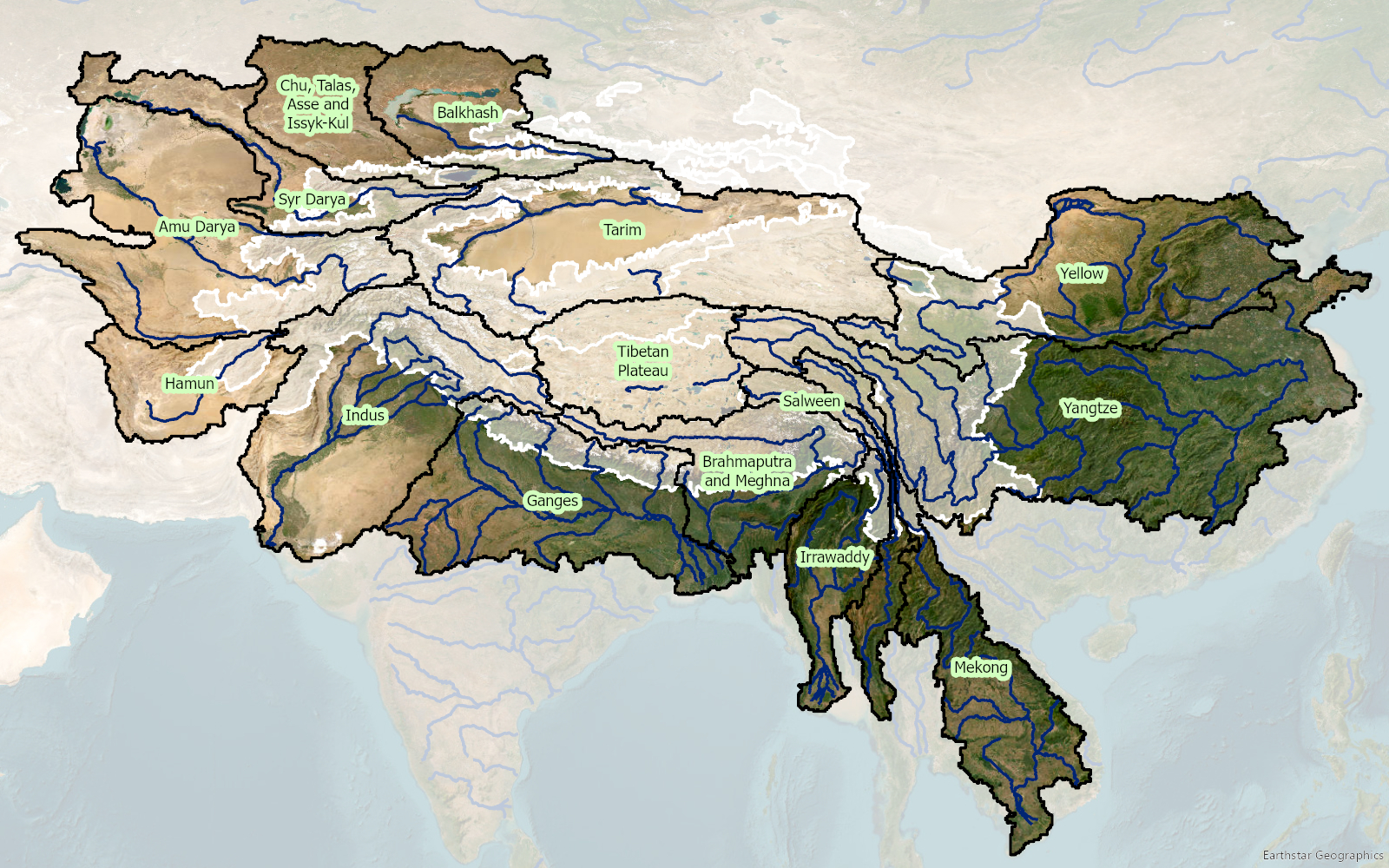
Cuencas fluviales con origen en las altas montañas de Asia incluidas en el proyecto 3POLE4FOOD. El polígono blanco indica las zonas de alta montaña.

La evaluación proporcionó un análisis estructurado de los riesgos climáticos actuales y futuros para el sistema general de abastecimiento de agua y para los componentes clave de la infraestructura, entre los que se incluyen las plantas de tratamiento de agua, las tuberías de transporte, los centros de distribución de agua, los sistemas inteligentes de gestión del agua y las instalaciones de laboratorio y de tecnologías de la información. Se prestó especial atención a la planta de tratamiento de agua de Kampyrravat y a la infraestructura de transporte asociada en Andijan, a la tubería de transporte Kungrad-Muynak y a la planta de tratamiento de agua de Tuyamuyun en Karakalpakstán. El trabajo también tuvo en cuenta el papel de la mejora de la monitorización, la telemetría, los sistemas SCADA y las zonas de medición por distritos en el fortalecimiento de la resiliencia operativa ante la creciente variabilidad climática.

FutureWater analizó los riesgos climáticos relevantes para la zona del proyecto, incluyendo inundaciones, olas de calor, sequía y escasez de agua, deslizamientos de tierra provocados por las lluvias, incendios forestales, salinización de las aguas subterráneas y riesgos sísmicos. La evaluación combinó el análisis de índices climáticos con un examen de la exposición y la vulnerabilidad a nivel de componentes para identificar cómo los cambios previstos en la temperatura, los extremos de precipitación, los días secos consecutivos y la estacionalidad de la escorrentía a largo plazo podrían afectar a la disponibilidad de agua, el rendimiento del tratamiento, la fiabilidad de las infraestructuras y la continuidad del servicio.

Los resultados se utilizaron para definir y justificar las medidas de adaptación climática en el diseño del proyecto. Entre ellas se incluyen la elección de emplazamientos resistentes a las inundaciones y mejoras en el drenaje, materiales resistentes al calor y protección de las infraestructuras expuestas, protección contra la erosión a lo largo de los corredores de las tuberías, almacenamiento adicional y medidas operativas para los periodos de sequía, mejora de la monitorización de la calidad del agua y sistemas inteligentes de gestión del agua para reducir el agua no facturada y facilitar una respuesta rápida durante las interrupciones relacionadas con el clima. La evaluación también contribuyó a la justificación de la financiación climática del proyecto, incluida la identificación de inversiones relevantes para la adaptación en consonancia con las directrices del Banco Asiático de Desarrollo (ADB) y los bancos multilaterales de desarrollo.

A través de este trabajo, FutureWater ayudó a reforzar la justificación climática de una importante inversión en el sector del agua en Uzbekistán. La evaluación respalda el desarrollo de servicios de agua potable más fiables, eficientes y resilientes al clima para las comunidades de Andijan, Ferganá y Karakalpakstán, al tiempo que contribuye a la seguridad hídrica a largo plazo en un contexto de creciente estrés climático.

The Central Asia Regional Economic Cooperation (CAREC) Program is a partnership of 11 countries from Central Asia, South Asia, the Caucasus, as well as Mongolia and the People’s Republic of China and works to increase regional cooperation to help the region shift to low carbon development pathways and build resilience against climate induced hazards. ADB hosts the CAREC secretariat and helps to facilitate projects that deliver regional benefits.

In 2017, CAREC introduced agriculture and water as a new pillar under the CAREC 2030 strategy to provide a conducive and trusted platform to foster regional cooperation and integration on water security. The water pillar was established in 2020 and its scope was devised in 2022. Since then, a number of activities and consultations with CAREC countries have been undertaken including provision of a long list of potential regional projects that could be financed by ADB.

In this project prefeasibility studies will be conducted for three selected priority projects:

  1. Climate change adaptation through improving irrigation efficiency in the Aral Sea Basin
  2. Climate Resiliency of Bakhri Tojik reservoir for improved irrigation and energy supply
  3. Joint Automated Water Metering System in the Aral Sea Basin

The prefeasibility studies entail:

  • Technical, financial, economic, poverty and social analysis.
  • Environment, social, and indigenous people’s safeguards assessments.
  • Climate change assessments.
  • Financial management and procurement capacity assessments; and
  • Institutional set-up and project implementation arrangements.

For these prefeasibility studies FutureWater conducts the climate risk assessment.

Uzbekistan is one of the fastest-growing economies in Central Asia, driving a steady rise in energy demand. However, the country faces significant power shortages due to increasing consumption, declining efficiency of aging power plants, and mounting climate pressures, particularly in regions like Tashkent, Samarkand, and Sirdarya. In response, Uzbekistan is prioritizing renewable energy development, especially solar power, to reduce its reliance on fossil fuels. With its abundant sunlight, the country is well-positioned to harness solar energy, and several large-scale photovoltaic (PV) projects are currently in progress.

With the support of the Asian Development Bank, Uzbekistan aims to strengthen energy security and promote environmental sustainability by developing three solar PV plants (100 MW, 400 MW, and 500 MW), two substations, two battery energy storage system (BESS) facilities, and associated transmission lines across Samarkand, Bukhara, Jizzakh, Sirdarya, and Tashkent provinces. To identify the exposures and vulnerabilities of these project components to potential climate risks, FutureWater will utilize advanced downscaled Coupled Model Intercomparison Project Phase 6 (CMIP6) ensembles, along with relevant hazard data and local information, to conduct a rapid Climate Risk Assessment (CRA). The insights gained will enable the Asian Development Bank (ADB) to implement effective adaptation measures and ensure climate-resilient development.

The UNDP is implementing the project “Conservation and sustainable management of lakes, wetlands, and riparian corridors as pillars of a resilient and land degradation-neutral Aral basin landscape supporting sustainable livelihoods” to enhance the resilience of the ecosystems and livelihoods in Lower Amudarya and Aral Sea Basin (LADAB) through land degradation neutrality (LDN) compatible integrated land-water management.

This assignment contributes to water allocation analysis and the development of water supply scenarios for irrigated agriculture and biodiversity conservation reports. The services consist in:

  1. Consulting with project experts, government agencies, local communities, and other relevant stakeholders
  2. Develop a hydro-economic water allocation model for the lower Amu Darya basin using WEAP
  3. Explore different scenarios for irrigated agriculture and biodiversity conservation, considering climate change, to strike a balance between sustainable agricultural practices and conservation of biodiversity and ecosystems and (iv) build capacity and support project experts and relevant stakeholders on water allocation analysis and modelling.
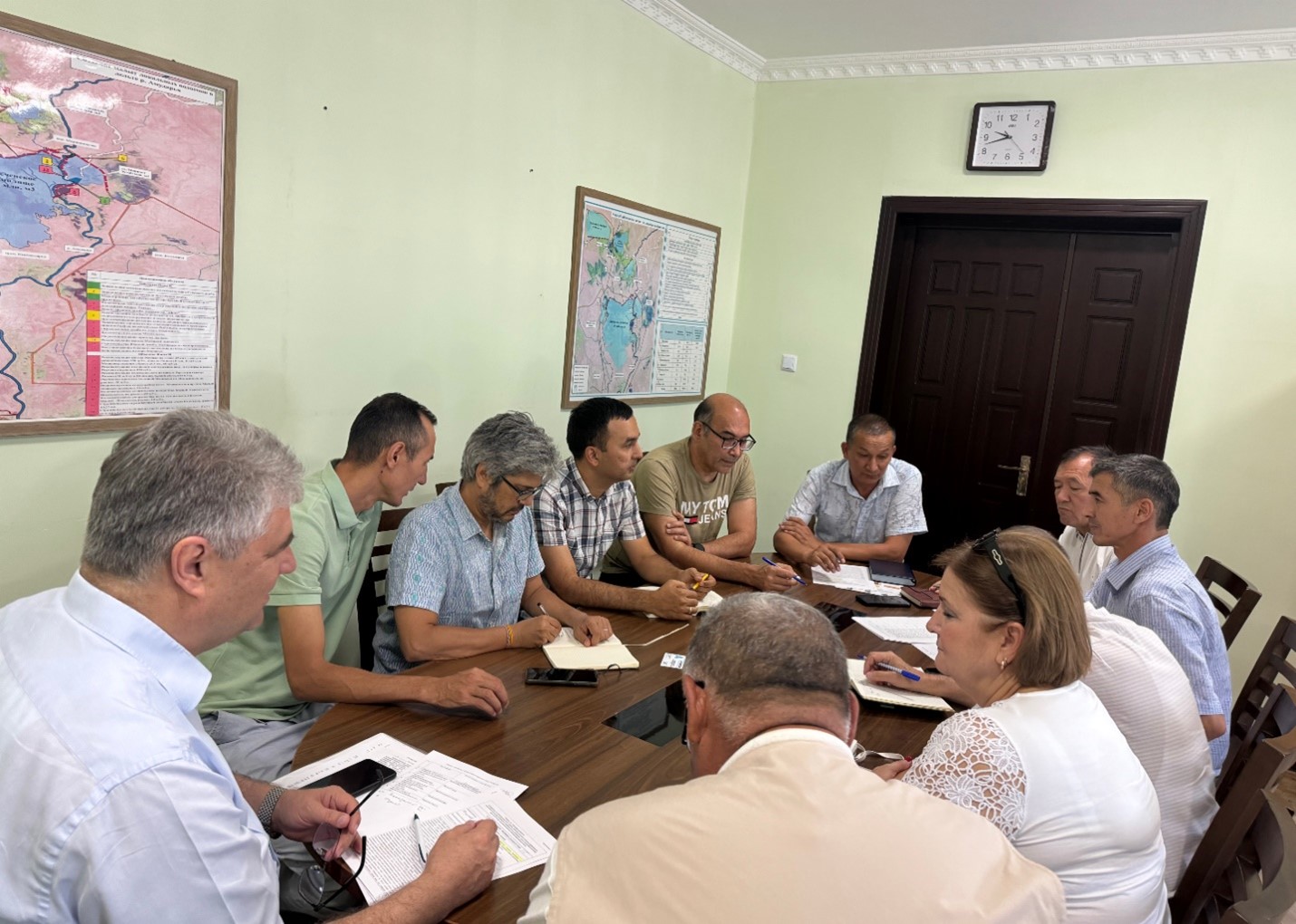
Stakeholders consultation in Nukus, Uzbekistan

The project prepares robust climate mitigation and adaptation pipelines aligned with the Paris Agreement and responsive to DMCs climate change priorities. The TA will support interventions on departmental, sectoral and country levels with key activities including development of a regional strategy, upstream climate assessments, climate pipeline development, government dialogues and capacity building. As part of this project, FutureWater conducts a regional climate risk assessment for ten countries. This includes an assessment of baseline and future climate hazards, exposure and vulnerability and addressing sectoral impacts and adaptation options for a wide range of sectors. In addition country profiles summarizing climate risks for the ten countries are generated. The reginal climate risk assessment feeds into the climate strategy.

With over 1,850 km of 500kV lines, 6,200 km of 220kV lines and 15,300 km of 110kV lines, the power transmission system in Uzbekistan is facing challenges with respect to deteriorating infrastructure and unreliable power supply. To address these issues, the Asian Development Bank (ADB) is assisting the Government of Uzbekistan through the “Uzbekistan Power Transmission Improvement Project” which aims to: i) improve the power transmission network capacity and reliability in the northwest region of the country, ii) reduce transmission losses, and iii) improve the operational efficiency of the power sector. This will be done through the i) construction of a new 220kV single-circuit overhead transmission line spanning over 364 km, ii) expansion, rehabilitation, and construction of 3 substations and iii) capacity building and institutional development.

Additionally, given the growing impacts of climate change in the region, FutureWater has been assigned to carry out a climate risk and adaptation assessment for 12 transmission lines and 2 substations in the country. FutureWater will make use of state-of-the-art downscaled Coupled Model Intercomparison Project Phase 6 (CMIP6) ensembles, and other relevant hazards and local information to develop this CRA. The insights from this assessment will enable ADB to justify climate financing for further enhancing the climate resilience of the grid system. Moreover, through the adoption of climate-resilient technologies and adaptation measures based on the climate risk assessment, the country will be able to cut down on their GHG emissions and ensure uninterrupted power supply in light of a changing climate. This will be complimented by deriving adaptation costs to justify the need for climate financing. In addition, FutureWater will also be reviewing the existing meteorological monitoring network and recommending additional potential monitoring sites for improved surveillance in the country.

With a target to increase the gross domestic product from $70 billion in 2021 to $160 billion by 2030, the Government of Uzbekistan is taking steps to ensure that it will be able to meet the spike in electricity demand which is expected to double by 2030. Initiatives include installing an additional 17 gigawatts capacity to the existing available capacity of 12.9 GW, out of which 8 GW will be from renewable energy projects. Currently, the distribution system in Uzbekistan comprises of more than 260,000 kilometers of 0.4-110 kV networks, 1,655 substations and more than 86,000 transformer points. However, more than 50% of the lines have been operational for 30 years and 30% of the substation transformers are in dire need of rehabilitation. Therefore, the Asian Development Bank is working closely with the Joint Stock Company Regional Electric Power Networks (JSC REPN) to: i) Rehabilitate and modernize the distribution substations, ii) Rehabilitate associated distribution lines, and iii) Enhance the institutional capacity for financial sustainability and climate resiliency.

These rehabilitation efforts will also take into account and address the growing impacts of climate change in the region. For this, FutureWater has been assigned to carry out a climate risk and adaptation assessment (CRA). FutureWater will make use of state-of-the-art downscaled Coupled Model Intercomparison Project Phase 6 (CMIP6) ensembles, and other relevant hazards and local information to develop this CRA. Insights from the CRA will be used to devise adaptation strategies. Additionally, FutureWater will be reviewing the existing meteorological monitoring network and recommending additional potential monitoring sites for improved surveillance in the country. To further assist the Government of Uzbekistan actualize its second Nationally Determined Contribution (NDC) agenda which seeks to reduce greenhouse gas (GHG) emissions per unit of GDP by 35% (compared to the level in 2010), by the year 2030, FutureWater will also develop a GHG account and prepare a Paris Agreement alignment assessment.

En las últimas décadas, la gestión eficiente de los recursos hídricos ha sido un elemento importante de las políticas hídricas de la UE, un tema que recibe una atención renovada en la Estrategia de Adaptación de la UE revisada en 2021, que destaca la necesidad de un enfoque basado en el conocimiento hacia tecnologías e instrumentos de ahorro de agua, como la asignación eficiente de recursos hídricos. El informe especial del IPCC sobre los océanos y la criosfera en un clima cambiante (2019) destaca la combinación de la gobernanza del agua y los riesgos climáticos como posibles causas de tensiones sobre los recursos hídricos escasos dentro y a través de las fronteras, especialmente debido a la competencia entre la demanda de energía hidroeléctrica y riego en cuencas hidrográficas transfronterizas alimentadas por glaciares y nieve en Asia Central.

El enfoque innovador de WE-ACT consiste en dos acciones de innovación complementarias: la primera es el desarrollo de una cadena de datos para un sistema de información hídrica fiable, que a su vez permite la segunda, a saber, el diseño y la implementación de un sistema de apoyo a la toma de decisiones (DSS) para la asignación de agua. La cadena de datos para el sistema de información hídrica fiable se compone de tecnología de monitoreo hidrometeorológico y glaciológico in situ en tiempo real, modelización del sistema hídrico (incluida la modelización de la oferta y demanda de agua y evaluaciones de la huella hídrica) y balance de masa glaciar, tecnología de almacenamiento de datos y aprendizaje automático.

La implementación del DSS para la asignación de agua informada por el riesgo climático incluye análisis de actores e instituciones, métodos de valoración del agua, configuración del sistema de información hídrica para permitir una interfaz fácil de usar, desarrollo de casos de uso para la asignación de agua y retroalimentación sobre el uso del agua a través de diálogos políticos nacionales.

El trabajo de FutureWater dentro del estudio WE-ACT se centrará en estimar la demanda de agua y las huellas hídricas de los diferentes usuarios y actividades dentro de la cuenca del río Syr Darya. Por lo tanto, se evaluarán los efectos de la asignación de agua sobre las huellas hídricas, la demanda de agua insatisfecha y las violaciones del caudal ambiental mediante el uso de un conjunto de modelos hidrológicos como SPHY y modelos de asignación de agua (WEAP). Esto se realizará tanto para la situación actual como para escenarios futuros.

Para obtener más información, puede visitar el sitio web del proyecto WE-ACT.

With over 1,850 km of 500kV lines, 6,200 km of 220kV lines and 15,300 km of 110kV lines, the power transmission system in Uzbekistan is facing challenges with respect to deteriorating infrastructure and unreliable power supply. To address these issues, the Asian Development Bank (ADB) is assisting the Government of Uzbekistan through the “Uzbekistan Power Transmission Improvement Project” which aims to: i) improve the power transmission network capacity and reliability in the northwest region of the country, ii) reduce transmission losses, and iii) improve the operational efficiency of the power sector. This will be done through the i) construction of a new 220kV single-circuit overhead transmission line spanning over 364 km, ii) expansion, rehabilitation, and construction of 3 substations and iii) capacity building and institutional development.

Additionally, given the growing impacts of climate change in the region, FutureWater has been assigned to carry out a climate risk and adaptation assessment for 12 transmission lines and 2 substations in the country. FutureWater will make use of state-of-the-art downscaled Coupled Model Intercomparison Project Phase 6 (CMIP6) ensembles, and other relevant hazards and local information to develop this CRA. The insights from this assessment will enable ADB to justify climate financing for further enhancing the climate resilience of the grid system. Moreover, through the adoption of climate-resilient technologies and adaptation measures based on the climate risk assessment, the country will be able to cut down on their GHG emissions and ensure uninterrupted power supply in light of a changing climate. This will be complimented by deriving adaptation costs to justify the need for climate financing. In addition, FutureWater will also be reviewing the existing meteorological monitoring network and recommending additional potential monitoring sites for improved surveillance in the country.
